To implement the national innovation-driven development strategy, foster the growth of new quality productive forces, deepen the integration of science, education, and industry between Shandong and Hong Kong, and build an international bridge for scientific research innovation and technology transfer, on August 27, 2026, Qingdao University of Technology and the Hong Kong Institute of Technology (Hong Kong Institute of Technology Research Group Co., Limited) formally signed a strategic cooperation agreement. The two parties will jointly establish an embodied intelligence collaborative innovation platform, pioneer a new model for two-way technology transfer between Shandong and Hong Kong, and inject core momentum into the upgrading of high-end intelligent equipment industries and the high-quality development of regional scientific and technological innovation.
Complementary Advantages: Jointly Building a Benchmark for Industry-Academia-Research Collaborative Innovation
Chen Wei, Standing Committee Member of the Party Committee and Head of the United Front Work Department of Qingdao University of Technology, along with relevant leaders and faculty representatives from the University’s Cooperation and Development Office, School of Artificial Intelligence, and Technology Transfer Center, attended the signing ceremony. Fang Junyan, Director of the New Energy Division at the Hong Kong Institute of Technology and Foreign Academician of the Serbian Academy of Sciences and Arts, led his core project team and core Researcher to the event. The two sides conducted comprehensive and in-depth discussions and exchanges on core topics including deep industry-academia-research cooperation, cutting-edge technology breakthroughs, joint talent cultivation, and commercial application of industrial achievements.
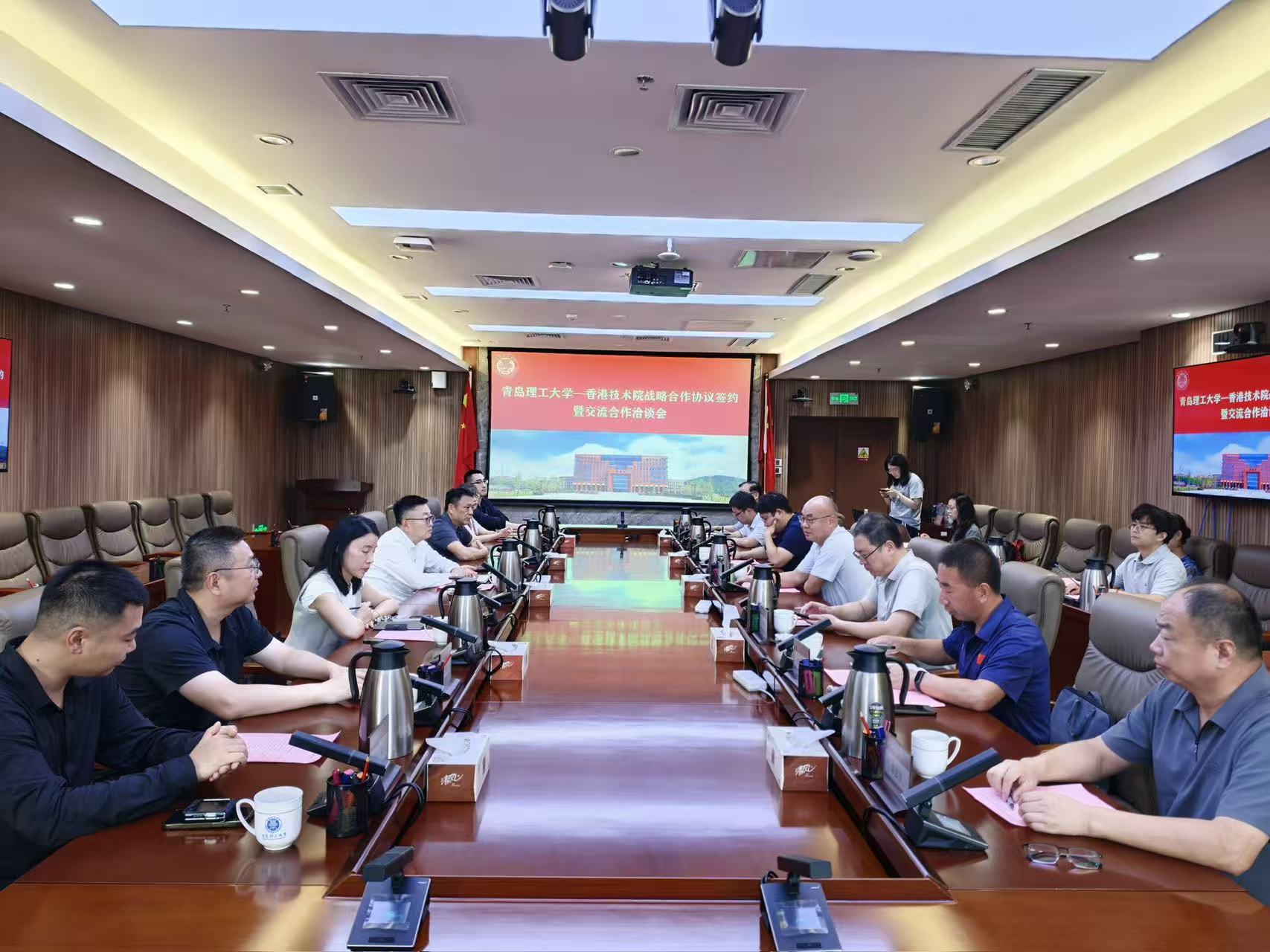 Meeting venue
At the symposium, Chen Wei extended a warm welcome to the visiting delegation from the Hong Kong Institute of Technology and provided a detailed introduction to Qingdao University of Technology’s distinctive strengths, advantageous discipline layout, scientific research innovation platform development, and achievements in industry-academia-research integration. He noted that Qingdao University of Technology, as a key university in Shandong Province, has been deeply engaged in engineering fields such as civil engineering and architecture, mechanical manufacturing, artificial intelligence, and intelligent equipment for decades, with strong disciplinary foundations and solid research capabilities. Rooted in Shandong’s trillion-level manufacturing industry and leveraging the rich industrial application scenarios of the Jiaodong Peninsula, the University holds exceptional advantages in pilot-scale verification and industrial commercialization of cutting-edge technologies. Embodied intelligence and artificial intelligence are core tracks leading the current technological revolution. This partnership with the Hong Kong Institute of Technology represents a major strategic move for the University to connect with international frontier innovation resources and break through key technological barriers. The University will fully leverage its four core advantages in disciplines, talent, application scenarios, and industry to ensure the effective implementation of bilateral cooperation and set a benchmark for university-institute collaborative innovation.
Resource Convergence: Unlocking the Pathway for International Frontier Technology Deployment
Fang Junyan provided a comprehensive overview of the Hong Kong Institute of Technology’s platform positioning, international innovation resource layout, global research collaboration network, and cutting-edge technological achievements. He pointed out that Hong Kong, as the nation’s international innovation and technology hub, enjoys a unique window advantage in connecting with world-class technologies, top-tier talent, and industrial capital. The Hong Kong Institute of Technology, based in Hong Kong, backed by the motherland, and connected to the world, has long been dedicated to global technological research and cross-border innovation collaboration, establishing a mature international think tank system capable of precisely aggregating and importing internationally advanced core technologies and high-quality industrialization projects in embodied intelligence, intelligent perception, and motion control.
Fang Junyan emphasized that the innovation resources of Shandong and Hong Kong are highly complementary, with vast space for cooperation. Hong Kong excels in global technology connectivity and frontier research and development, while Shandong boasts notable advantages in engineering deployment, pilot-scale incubation, and industrial application. Qingdao University of Technology’s engineering research strength, combined with Shandong’s robust manufacturing base, precisely fills the critical gap in bringing internationally frontier technologies into mainland industrial application scenarios. This strategic cooperation aligns precisely with the national strategy for intelligent industry development, and the two parties will break down geographical barriers to build a new cross-regional, international pattern of scientific and technological innovation cooperation.
Full-Chain Layout: Ushering in a New Model of Shandong-Hong Kong Innovation Cooperation
At the ceremony, representatives of both parties formally signed the long-term strategic cooperation agreement, marking the official commencement of regularized and in-depth cooperation between Qingdao University of Technology and the Hong Kong Institute of Technology. Under the agreement, the two parties will jointly establish the “Qingdao University of Technology Embodied Intelligence Frontier Technology and Project Collaboration Center,” building a professional, open, and international innovation collaboration platform with long-term mechanisms for technology matching, research collaboration, and project incubation.
In terms of core cooperation priorities, the two parties will focus on frontier fields such as embodied intelligent robots, high-end intelligent equipment, and artificial intelligence algorithms, innovatively establishing a full-chain innovation model of “Hong Kong international resource connectivity — joint cross-regional R&D and validation — Qingdao pilot-scale adaptation — Shandong-wide incubation and transfer — nationwide industrial application.” This will bridge the last mile from laboratory to production line for frontier technologies. In parallel, the two parties will regularly conduct researcher exchange visits and joint cultivation of young innovation talent, and will engage quality industrial capital and leading industry enterprises to accelerate the commercialization of cutting-edge research outcomes, addressing the industry-wide pain points of difficult technology transfer from universities and the challenges of deploying international technologies locally.
Future-Oriented: Continuously Empowering the Upgrading of the National Intelligent Industry
This university-institute strategic cooperation represents a landmark achievement in Shandong-Hong Kong science and education integration and innovation collaboration, carrying significant innovative value and demonstrative significance. At the regional level, the cooperation effectively combines Hong Kong’s international innovation resources with Shandong’s real-economy industrial strengths, helping drive the digital and intelligent transformation and upgrading of Shandong’s manufacturing sector. At the industry level, it pioneers a replicable and scalable new model for cross-border technology transfer, providing a fresh template for universities nationwide to connect with international innovation resources. At the national strategic level, it deeply serves the national strategic emerging industry layout for artificial intelligence and advanced manufacturing, contributing to the development of Hong Kong as an international innovation and technology center and accelerating the growth of new quality productive forces in the mainland.
Looking ahead, the two parties will rigorously implement the strategic cooperation agreement, establish a long-term working mechanism featuring annual high-level meetings and routine daily liaison, and standardize practices in intellectual property protection and benefit sharing of research outcomes to ensure efficient and sustainable cooperation. The two parties will continue to expand the scope of cooperation, deepen their presence in the frontier embodied intelligence track, and, through cross-regional collaborative innovation, continuously empower the high-quality development of scientific and technological innovation in both Shandong and Hong Kong and the innovation-driven upgrading of the national intelligent industry.