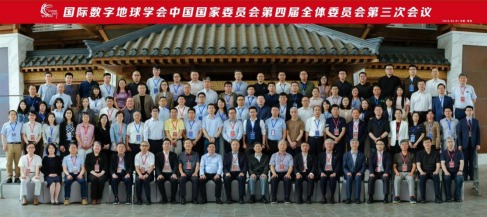
From June 5 to 7, 2026, the Third Meeting of the Fourth Plenary Committee of the Chinese National Committee of the International Society for Digital Earth and the Fourth China Digital Earth Summit were held in Qingdao. Centering on the core theme of Digital Earth supporting global and China’s sustainable development, this series of events brought together over 1,300 scientists, administrators, entrepreneurs, and representatives from various sectors in the field of Digital Earth for three days of in-depth discussion and exchange. The Summit featured more than 60 parallel session reports across four major directions: frontiers of Digital Earth methodologies, technological innovation, application services, and the development of young and women scientists, comprehensively showcasing China’s cutting-edge technologies, latest achievements, and practical application cases in the Digital Earth field. This year marks the 20th anniversary of the Chinese National Committee of the International Society for Digital Earth, and the China Digital Earth Qingdao Declaration was officially released at the Summit, becoming an important milestone for industry development.
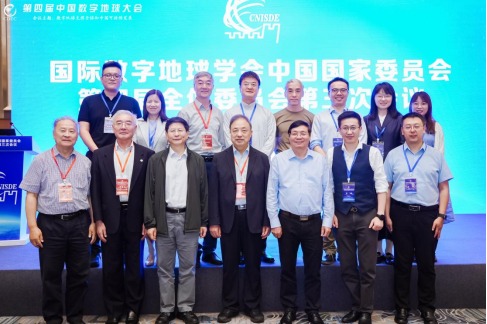
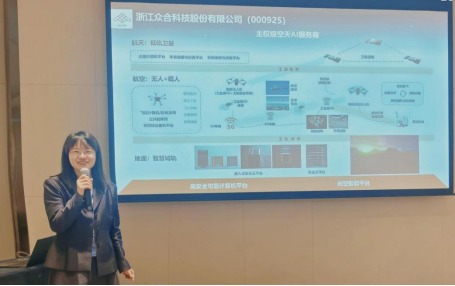
Xie Xiao, Director of our institute’s Spatiotemporal Intelligent Systems Engineering Center (hereinafter referred to as “the Center”), attended the Summit and chaired a sub-forum. Within the system of 21 professional committees under the Chinese National Committee of the International Society for Digital Earth, Xie Xiao serves as Secretary-General of the Digital Heritage Professional Committee, Deputy Director of the North China Region of the Women Scientists Working Committee, and is also a member of the Spatial Information Industrialization Professional Committee. During the forum exchange session, Xie Xiao also delivered a presentation themed on sovereign-level space-air AI spatiotemporal intelligent systems engineering, inviting industry teams such as Zhejiang United Science and Technology (000925), Hygon Information Technology (688041), and Sigma Spatiotemporal Intelligent Computing to showcase their collaborative modules. As important product components of the spatiotemporal intelligent systems engineering, these software-hardware collaborative intelligent control and integration platforms, which possess first-mover advantages in industrial product form, enable highly elastic computing resource scheduling for complex scenario tasks and integrated command capabilities for multimodal intelligent agents encompassing collective perception, cognition, and action, opening up a new product track for AI popularization and the shared intelligent economy.
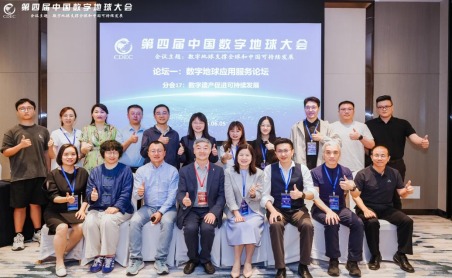
Standing at the new starting point of the 20th anniversary of the Chinese National Committee of the International Society for Digital Earth, this series of meetings consolidated industry consensus and deepened technological exchange. In the future, Digital Earth technology will continue to deeply empower the United Nations 2030 Agenda for Sustainable Development, continuously injecting strong scientific and technological momentum into global governance, ecological civilization construction, cultural heritage preservation, and high-quality economic development.