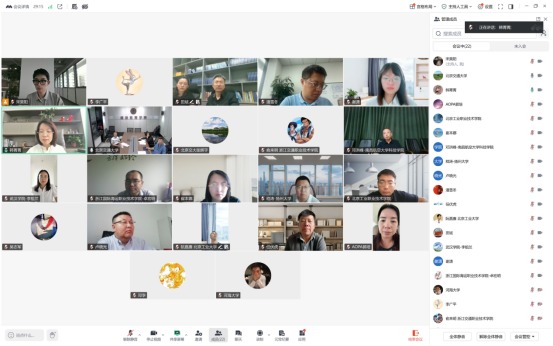
To thoroughly implement the national strategic deployment for the development of the low-altitude economy and to promote the deep integration of the education chain, talent chain, industrial chain, and innovation chain, the first batch of applicant institutions’ defense and review meeting for the Low-Altitude Economy Smart Learning Workshop / MIIT International Low-Altitude Economy Industry College Project, jointly initiated by the Center for School Planning and Development of the Ministry of Education, Beijing MIIT International Technology Development Co., Ltd., and Xuandu Space-Time Cloud Education Technology (Beijing) Co., Ltd., was successfully convened online on May 25, 2026.
I. Project Background and Review Overview
As a strategic emerging industry, the low-altitude economy is characterized by its long industrial chain, broad reach, and strong driving force, yet it is currently facing a structural gap between talent supply and industrial demand. Since the project opened for applications in early 2026, consultations and application intentions have been received from more than 60 institutions nationwide. After preliminary review and communication, and taking into comprehensive consideration of factors such as institutional infrastructure, regional industrial layout, professional cluster alignment, and resource guarantee capabilities, 15 institutions—including Beijing Jiaotong University, Hohai University, Beijing University of Technology, Yangzhou University, Xichang College, Wuhan College, Beijing Polytechnic College of Industry, and Zhejiang Vocational and Technical College of Transportation—advanced to this defense round. The participating institutions span different levels of education, including Double First-Class universities, application-oriented undergraduate institutions, and vocational colleges, fully reflecting the project’s broad influence and diverse participation.
II. Authoritative Experts Gathered, Rigorous Review Quality Control
A review committee comprising multiple authoritative experts in the fields of low-altitude economy and industry-education integration was convened for this defense and review meeting: Tian Bin, Director of the Industrial Economy Research Institute of the International Economic Cooperation Center of the Ministry of Industry and Information Technology (MIIT), General Manager of Beijing MIIT International Technology Development Co., Ltd., and Director of the International Exchange and Cooperation Special Committee of the MIIT Low-Altitude Industry Alliance; Ren Fuhu, Dean of the Institute of Earth and Space Technology at Peking University Lingang Science and Technology Innovation Center; Guo Pei, Deputy Secretary-General of the China AOPA Association; Lu Xiaoguang, Deputy Dean of the School of Electronic Information and Automation at Civil Aviation University of China; and Xie Xiao, Deputy Director of the Provincial Key Laboratory of the Shenyang Institute of Applied Ecology, Chinese Academy of Sciences / Director of the HKRIT Spatio-Temporal Intelligent Systems Engineering Center.
Li Guangping, an official from the Innovation and Development Division of the Center for School Planning and Development of the Ministry of Education, presented the project overview. The meeting was moderated by Han Jingjing, General Manager of Xuandu Space-Time Cloud Education Technology (Beijing) Co., Ltd.
III. Institutions Presented Their Distinctive Features; Expert Review Was Meticulous and Standardized
During the defense session, each applicant institution delivered a timed presentation in alphabetical order of institution names, with a total duration of no more than 15 minutes per institution—within which the project presentation was limited to 10 minutes and expert Q&A accounted for approximately 5 minutes. Each institution delivered an impressive presentation covering key content such as its foundational conditions, the positioning and planning of project construction, connections with the regional low-altitude industry, and resource investment and safeguard measures.
The review experts focused on key directions including low-altitude safety, low-altitude operations, and low-altitude intelligent technologies, and conducted in-depth questioning and evaluation of each applicant institution from dimensions such as the feasibility of deep industry-education integration, regional industry service capabilities, the quality of professional system development, and practical training condition guarantees, fostering a vibrant atmosphere of onsite discussion.
IV. Review Results and Subsequent Arrangements
After all institutions had completed their defenses, the expert review panel conducted closed-door comprehensive scoring. Combining their review of application materials and onsite defense performance, the experts categorized institutions according to their differing educational levels—Double First-Class universities, application-oriented undergraduate institutions, and vocational colleges—and took into comprehensive consideration of multiple factors including regional geographical distribution, public or private institutional status, and the degree of institutional cooperation, ultimately forming the recommended list for the first batch of project construction institutions.
The selection results will subsequently be published on the official website of the Center for School Planning and Development of the Ministry of Education and will be delivered to the selected institutions in the form of an official red-headed written document. The selected institutions will jointly advance project construction with Xuandu Space-Time Cloud Education Technology (Beijing) Co., Ltd. Through co-building industry-education integration platforms and jointly cultivating urgently needed industry talent, they will develop a discipline and professional cluster and a modular curriculum system covering the entire low-altitude economy industrial chain, providing solid talent and capability support for the healthy development of the low-altitude economy industry.
V. Future Outlook
The Low-Altitude Economy Smart Learning Workshop / MIIT International Low-Altitude Economy Industry College Project is positioned with the overall orientation of “deep industry-education integration, digital-intelligent technology empowerment, and practical capability orientation.” It focuses on key directions including low-altitude safety, low-altitude operations, and low-altitude intelligent technologies, and aims to build a comprehensive talent cultivation platform integrating talent development, technical practical training, industrial services, and innovation incubation—committed to establishing national standards in the low-altitude economy sector and promoting the internationalization of China’s vocational education model.
The selection and implementation of the first batch of construction institutions will provide benchmark demonstrations for institutions nationwide in the development of emerging disciplines such as low-altitude safety and the low-altitude intelligent internet of things, forming a replicable and scalable new paradigm of industry-education integration. In the future, the project will continue to accept applications from universities and vocational colleges nationwide, promote the deep integration of the education chain, talent chain, industrial chain, and innovation chain, and jointly usher in a new era of intelligent, efficient, and sustainable low-altitude development.